Take the free quiz to find the pattern underneath, and the Money Breathwork® experience made for it. 15 questions, about 3 minutes, instant result.
Free. Unsubscribe anytime.
You buy something for yourself, and then spend the rest of the day justifying it. You finally have a good month, and immediately start bracing for whether you can do it again. You have money in the bank, and you're still afraid to spend it.
None of that started with you. You're making money decisions as an adult, but some of the rules behind those decisions were written long before you had a bank account.
Money is a mirror of what we experienced as children, and of the patterns passed down in our families. Honestly, no matter what kind of upbringing you had, you picked up money rules along the way. Some of them serve you. Some of them are quietly running your bank account.
Here are nine of the most common childhood money beliefs I see, how they show up in your adult life, and how to start rewriting them.
The breathwork for the money rules you grew up with
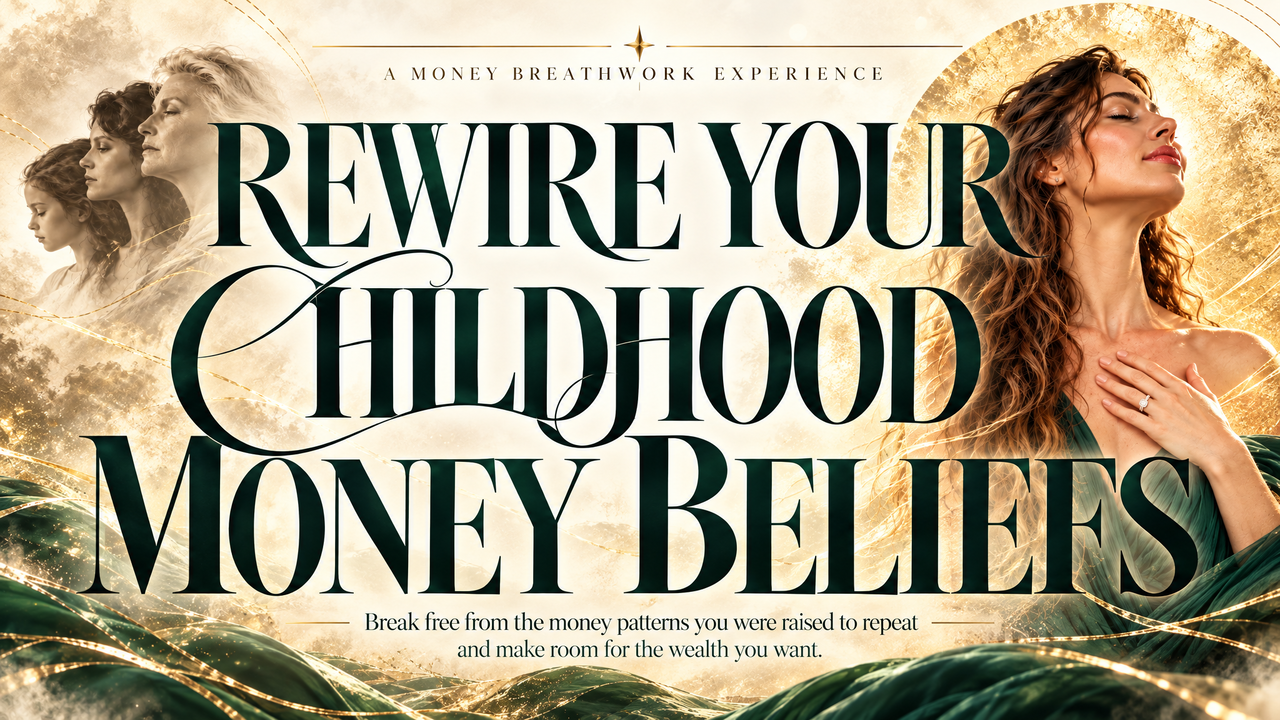
Rewire Your Childhood Money Beliefs
The money rules you grew up with are still making your decisions.
Rewire Your Childhood Money Beliefs takes you back to where your money story started, so you can release the rules you're done carrying and choose the relationship with money you actually want now. You begin with whatever is showing up for you today. No perfectly organized explanation of your childhood required.
A rule about money you absorbed growing up, from what you heard, what you watched and what you felt in your home, that still shapes how you earn, spend, save and receive as an adult. Often it was never said out loud. You just learned it.
Maybe someone said these things to you. Don't ask for too much. Money doesn't grow on trees. We can't afford that. Maybe nobody had to. You watched. You felt the tension in the house when money came up. You saw what happened when you asked for something. And you carried it with you.
Where childhood money beliefs come from
Your money programming gets coded in a few ways. Some of it comes before you're even born, through the patterns passed down in your family line. Some of it comes from childhood, as you learn from your environment and watch how the adults around you feel and act around money. And some of it comes from the money experiences you've had since.
Here's the part that changes how you work with it: your limiting beliefs aren't created by your mind. They're thoughts your mind created to support the programming already in your body. So the belief there's never enough isn't the root. It's the explanation your mind came up with for a feeling your body learned a long time ago.
This also isn't about blaming your parents. That's what intergenerational transmission is. Their parents passed their fears down to them, and their parents before that. Every generation hands down its money armor, usually without knowing it. You get to be the one who notices it, and puts it down.
My money story
Money moved through our house like weather
I grew up in a millionaire family. A big, beautiful house on the hill in one of the most affluent towns in the country, private schools, everything we wanted. I loved that house.
And then we went bankrupt when I was eight. I'm pretty sure the money struggles started when I was six or seven, because you don't just go bankrupt overnight. I don't have a lot of memories from that time, probably because there was so much stress in our house. Anger on one side, anxiety and fear on the other. And all of that got absorbed into my body in relation to money.
My dad was an entrepreneur. Tons of success, then bankruptcy. Tons of success again, then almost bankruptcy again. So when I built my own business, I already knew what entrepreneurship was supposed to feel like: up, then down. Celebrate, then brace.
For years I didn't even call it trauma. I'd look back and think my childhood was awesome. A lot of it was. But a lot of what I needed to heal was bundled together with money. I've done so much healing with that little girl who had no idea what was going on. And now I think about her all the time when I'm with my own kids.
Find your family's money rules
9 childhood money beliefs still holding you back
As you read, notice which ones make your body react. That reaction is usually your answer.
01
"Money can disappear at any moment."
Shows up as: never relaxing, even when the money is there. Bracing after every good month.
If you lived through a money loss as a kid, your body learned that money is not something you can count on. This was mine. After the bankruptcy, a part of me was always waiting for the floor to drop out again. As an adult, you might make as much as you can as fast as you can, because some part of you believes you could lose it all. Or you might not let yourself enjoy any of it, so it won't hurt as much if it goes.
02
"Business is a roller coaster."
Shows up as: big month, small month, over and over, and believing that's just how it works.
If you grew up watching a parent's business or job go up and down, the roller coaster can feel like home. You believe entrepreneurship is hard and takes sacrifice, so that's exactly how you live it. I knew I was holding this pattern. I could explain exactly where it came from. And I still lived it for years, because knowing it didn't change the feeling in my body that up is always followed by down.
03
"Don't ask for too much."
Shows up as: undercharging, not asking for the sale, apologizing when you name your price.
Maybe you learned that asking for things made the adults stressed or annoyed. Maybe you saw a sibling get in trouble for wanting more. So you got really good at not needing much. That's a beautiful skill in a kid who's trying to keep the peace. In a business owner, it looks like discounting before anyone asks, and feeling like a burden every time you send an invoice.
04
"Money causes problems."
Shows up as: avoiding money conversations, feeling tense when money comes up, not looking at your accounts.
If money was connected to yelling, fighting, silence or tears in your house, your body learned that money and danger go together. So as an adult, the topic itself feels charged. You might avoid opening your banking app, put off the money conversation with your partner, or feel your chest tighten when a client brings up payment. It isn't about the numbers. It's about what money used to mean in the room.
05
"You have to work hard for every dollar."
Shows up as: not trusting easy money, overdelivering, burning out to earn.
Maybe you watched what earning money cost your parents. Their time. Their marriage. Their happiness. So now you want to earn more, but a part of you doesn't want what it costs. Or you only trust money you've suffered for. When money comes easily, it feels suspicious, and you find a way to make it hard again so it feels earned.
06
"There's never enough."
Shows up as: feeling tight even in good months, saving everything, never feeling safe.
This one can come from real scarcity, or from adults who felt scarcity even when there was money. Either way, your body learned to treat more as temporary. As an adult, the number in your account changes, but the feeling doesn't. You make your money decisions from "there's never enough" instead of from your life today.
07
"Rich people are selfish."
Shows up as: keeping yourself from having "too much," feeling weird about wanting wealth.
I grew up thinking rich people were rude and selfish. But money is an amplifier. Are you a good person? Do you lead with your heart? Do you love on people and want to give? Money's going to amplify that. It's going to let you be a bigger version of who you already are. If part of you believes wealthy people are bad people, it'll quietly keep you from becoming one.
08
"Spending on yourself is selfish."
Shows up as: buying something for yourself, then justifying it all day. Guilt the moment you enjoy your money.
You might have watched a parent sacrifice everything for the family and never spend a dollar on themselves. Love looked like going without. So now, when you buy the thing, you feel like you've done something wrong. You can believe you deserve to enjoy your money, and still feel guilty the moment you do. That's the gap between what you know and what your body learned.
09
"Wanting more is disloyal."
Shows up as: playing it down around family, feeling guilty for outearning your parents, staying small to fit in.
This one is quiet and powerful. If your family struggled, wanting more can feel like you're leaving them behind or saying their way wasn't good enough. So you hold yourself at a level that feels familiar. Imagine wanting more without feeling disloyal to the family you came from. That's not betrayal. That's you getting to choose.
If three or more of those made your body react, that's exactly what Rewire Your Childhood Money Beliefs was made for: the woman who can see her childhood money beliefs showing up in her adult life, and is ready for a practice that includes her breath, her body and her emotions.
Knowing where it came from isn't enough
You can know your parents' financial struggles don't have to be yours, and still brace for something to go wrong. You can understand your money story perfectly, and still live it.
That's because the pattern doesn't live in what you understand. It lives in your body. I could tell you exactly where my roller coaster came from. Understanding it didn't stop me from riding it. What changed it was bringing my breath and my body into the work, so the old rules stopped making my decisions for me.
That's the work I do in Money Breathwork®. It's a guided breathwork practice made for your money and your business. You breathe through your mouth, into your belly, into your chest and out, and it drops you past your thinking mind into the place where these memories and feelings are stored. Then you get to release them, and choose something new.
“The pattern doesn't live in what you understand. It lives in your body.”
Inside the session
Where Rewire Your Childhood Money Beliefs takes you
You don't need to have your childhood figured out. You begin with whatever is showing up now, and I guide you through six stages.
01We ground youYou set your intention and settle into your body before the breath begins.
02We go back to where it startedThe conversations. The tension. The things you watched. What you decided money meant, and what it meant about you.
03We find where it's still running your lifeHow those early experiences show up in the way you earn, spend, save, work and decide today.
04We let go of what you're done carryingThrough the breath, you meet the feelings you've been holding and release the beliefs you no longer want making your money decisions.
05We give the younger you what she neededWhat does she need to hear? And what relationship with money do you get to choose now?
06We bring it homeYou choose the next money move you'll make from this new place, so the shift goes with you.
The rules you grew up with
"Don't ask for too much."
"Money causes problems."
"You have to work hard for every dollar."
"There's never enough."
"Enjoying money is selfish."
"Wanting more is disloyal."
The money you get to choose now
A number in your banking app, not a verdict.
Buying the thing, and enjoying it that night.
A great month, then planning the next one.
Decisions from your life today.
Wanting more without guilt.
Money that finally feels like yours.
Your kids are watching
If you have children, or nieces and nephews, or anyone young watching you, they're learning their money rules from you right now. Whether you enjoy what you buy, or apologize for it. Whether a good month feels like a celebration, or a countdown. Whether wanting more sounds exciting, or dangerous.
This isn't about getting it perfect. You were handed a money story you didn't choose. But whatever you don't rewrite, they inherit.
I think about this all the time with my own kids, and we have all these beautiful conversations. Not because I have it all figured out, but because I'm not willing to pass down the roller coaster. It gets to stop with you.
Find your family money rules
Give yourself fifteen quiet minutes and a journal.
Write down three things you heard about money growing up. Exact words, if you remember them.
Write down three things you watched: how the adults acted when money was tight, when it was good, when someone asked for something.
Write down what money felt like in your house. One or two words.
For each one, ask: what did I decide money meant? What did I decide it meant about me?
Picture yourself at the age when money first felt scary. What did she need to hear? Write it to her.
Circle the one rule you're most ready to stop living by. That's the one to breathe on first.
When it's not just childhood
Some money beliefs started in childhood and got reinforced by everything since: the first debt, the client who didn't pay, the launch that flopped. If you're working on beliefs that feel more about your adult money life, Rewire Your Limiting Money Beliefs is the twenty-minute session for those.
I'm a former therapist, and I still had to name my own childhood trauma. I didn't even call it trauma before. You can read more of my story here. You don't have to force a breakthrough. There's room to begin exactly where you are.
Free Money Breathwork® quiz
What’s Blocking Your Money Flow?
Take the free quiz to find the pattern underneath, and the Money Breathwork® experience made for it. 15 questions, about 3 minutes, instant result.
Free. Unsubscribe anytime.
Your questions
Frequently asked questions
What are childhood money beliefs?
They're rules about money you absorbed growing up, from what you heard, watched and felt at home. Common ones are "don't ask for too much," "money causes problems," "you have to work hard for every dollar" and "there's never enough." They often keep shaping how you earn, spend and receive as an adult.
How do I know which money beliefs came from my childhood?
Look at the money moments where your reaction feels bigger than the situation: guilt after a purchase, bracing after a good month, tension when money comes up. Then ask what money felt like in your house growing up. The match is usually clear.
Can you change beliefs you've had since childhood?
Yes. Knowing where a belief came from is the first step, but the pattern is stored in your body, so it usually takes body-level work to change how you respond. Guided breathwork helps you release the old rule and practice a new one.
Is it my parents' fault?
Not really. Money beliefs are passed down through generations. Your parents likely learned theirs from their parents. The point isn't blame. It's noticing what you inherited and choosing what you pass on.
How do I stop passing money beliefs to my kids?
Notice how you talk about and react to money in front of them. Let them see you enjoy what you buy, celebrate good months and talk about money calmly. Healing your own money story is the most powerful thing you can do for theirs.
What is Rewire Your Childhood Money Beliefs?
It's a guided Money Breathwork® experience with an introduction, journaling and a breathwork that takes you back to where your money story started, helps you release the rules you're done carrying, and ends with the next money move you'll make. Breathwork isn't a substitute for financial, medical or mental-health advice.
It gets to stop with you
You didn't get to choose what you experienced with money growing up. But you get to have a say in what happens next.
Pick the one rule that hit hardest when you read this. Notice it in a real money moment this week. And when you're ready to take it out of your body, not just your head, Rewire Your Childhood Money Beliefs is where I'd start.
“You didn't get to choose what you experienced with money growing up. But you get to have a say in what happens next.”
Featured breathwork
Rewire Your Childhood Money Beliefs
Break free from the money patterns you were raised to repeat, and make room for the wealth you want. You didn't get to choose what you experienced with money growing up. You get to have a say in what happens next.
Take the free quiz to find the pattern underneath, and the Money Breathwork® experience made for it. 15 questions, about 3 minutes, instant result.
Free. Unsubscribe anytime.
Written by
Alessandra Sollevare is the founder of Money Breathwork® and The All In Life. She's a former therapist, a former All-American college athlete and a worldschooling mama of four who helps women go all in on the life, money and business they want. Read her story →